
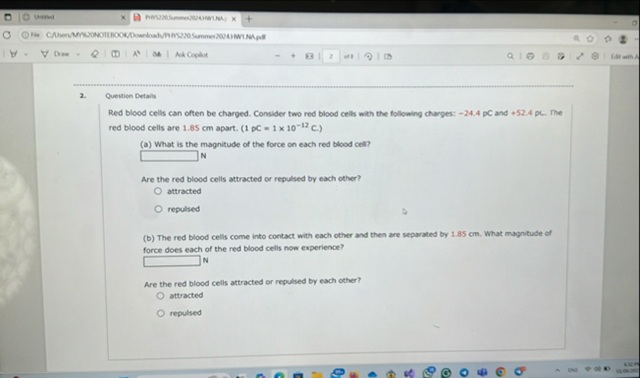
Red blood cells can often be charged. Consider two red blood cells with the following charges: -24.4 pC and 52.4 pL . The red blood cells are 1.85 cm apart. ( 1pC=1×10-12C.)(a) What is the magnitude of the force on each red blood cell?NAre the red blood cells attracted or repulsed by each other?attractedrepulsed(b) The red blood cells come into contact with each other and then are separated by 1.85 cm . What magnitude of force does each of the red blood cells now experience?◻ NAre the red blood cells attracted or repulsed by each other?attractedrepulsed
Answer
Electrostatic Force Between Two Charged Red Blood Cells
This analysis uses Coulomb’s Law to determine the force between two red blood cells, first before and then after they come into contact and share charge equally.
🔹 Step (a): Force Before Contact
Given:
- q₁ = −24.4 pC = −24.4 × 10⁻¹² C
- q₂ = +52.4 pC = +52.4 × 10⁻¹² C
- Distance r = 1.85 cm = 0.0185 m
Apply Coulomb’s Law:
🔹 Step (b): Nature of Force
One charge is negative, the other positive → opposite charges attract.
Result: The red blood cells are attracted to each other.
🔹 Step (c): Force After Contact and Redistribution
After contact:
- Total charge = −24.4 + 52.4 = 28.0 pC
- Each cell now has: qnew = 14.0 pC = 14.0 × 10⁻¹² C
New force calculation:
🔹 Step (d): Nature of Force After Contact
Both cells now carry positive charge → like charges repel.
Result: The red blood cells are now repelled by each other.
📊 Summary Table
| Part | Result |
|---|---|
| (a) | Force magnitude before contact: 3.36 × 10⁻⁸ N |
| (b) | Nature: Attracted |
| (c) | Force magnitude after contact: 5.15 × 10⁻⁹ N |
| (d) | Nature: Repelled |
✅ Conclusion
Using Coulomb’s Law, the initial attractive force between oppositely charged red blood cells was 3.36 × 10⁻⁸ N. After charge redistribution from contact, the cells became similarly charged and experienced a repulsive force of 5.15 × 10⁻⁹ N.